Vedette · Napoleonic Wars · 1798–1815
Exploring Officer
A Napoleonic scenario generator, and the great battles to fight again.
For wargamers. Not a history reference — games, built to keep the general in you fighting. Pick a theatre and a table; print the scenario.
Early release — £15 while the next major update is still being built, then the price rises. Feedback: feedback@vedette-wargames.com.
- Any rules
- Tables from 8 to 14 ft
- Inches or centimetres
- An evening a game: 10 to 16 turns, 20 to 74 units on the table
- Solo, umpired or two-player
- One file. Offline. Print it, send it.
A minute of it
The film is the app itself, driven a frame at a time — a reroll, then the sheet it printed: the staff map, the balance, both orders of battle, the objectives. Nothing in it is mocked up.
Sixteen battles, fifty-three engagements
Fought again, an evening at a time
Every battle is cut into the engagements that decided it. Each is a complete scenario on its own: its own table, its own map, both orders of battle, its own victory conditions. Play one, or fight the chain and carry the result forward.
| Battle | Year | Eng. | Units | The engagements |
|---|---|---|---|---|
| Austerlitz See the whole set, as the app prints it → | 1805 | 5 | 34–70 | five engagementsTelnitz and Sokolnitz · The Pratzen Heights · Staré Vinohrady — the Guard Counter-attack · The Santon and the Bosenitz Corridor · Aujezd and the Pond Causeway |
| Jena–Auerstedt | 1806 | 3 | 36–69 | three engagementsThe Landgrafenberg and Vierzehnheiligen · Hassenhausen · The Collapse toward Weimar |
| Eylau | 1807 | 3 | 41–63 | three engagementsThe Town · The Blizzard and the Russian Centre · Kutschitten and the Southern Flank |
| Friedland | 1807 | 2 | 62–64 | two engagementsSortlack Wood and the Loops of the Alle · Ney's Attack and the Town |
| Arroyo dos Molinos | 1811 | 2 | 24–26 | two engagementsThe town at dawn · The plain and the mountain |
| Fuentes de Oñoro | 1811 | 3 | 24–60 | three engagementsThe Village: First Storm · The Plain: Poço Velho and the Fighting Withdrawal · The Village: Second Storm |
| Borodino | 1812 | 4 | 25–61 | four engagementsShevardino Redoubt · The Bagration Flèches · Uvarov and Platov's Raid · The Raevsky Redoubt |
| García Hernández | 1812 | 1 | 20 | one engagementThe squares on the Serna slope |
| Krasny (Krasnoi) | 1812 | 3 | 21–56 | three engagementsThe Losvinka Gully: Eugene's Breakout · Napoleon's Gambit: The Guard's Feint and Davout's Escape · Ney's Rearguard: The Losvinka and the Ice of the Dnieper |
| Salamanca (Los Arapiles) | 1812 | 4 | 27–53 | four engagementsThe head of the column · Leith, Maucune and Le Marchant · Clausel's counter-attack · Ferey at El Sierro |
| Leipzig (the Battle of the Nations) | 1813 | 5 | 48–74 | five engagementsWachau and Liebertwolkwitz · Moeckern · Lindenau · Probstheida · The Bridge and the Rearguard |
| The Six Days — Champaubert, Montmirail, Château-Thierry and Vauchamps | 1814 | 4 | 34–55 | four engagementsChampaubert · Montmirail · Château-Thierry · Vauchamps |
| Ligny | 1815 | 3 | 45–68 | three engagementsSaint-Amand and Wagnelée · Ligny village · The Guard breaks the centre |
| Quatre Bras | 1815 | 2 | 60–70 | two engagementsPerponcher holds · Kellermann's charge and the Guards |
| Waterloo | 1815 | 5 | 33–72 | five engagementsHougoumont · D'Erlon's attack and the great charge · The squares and La Haye Sainte · Plancenoit · The Guard's last attack |
| The Waterloo Campaign | 1815 | 4 | 59–70 | four engagementsQuatre Bras · Ligny · Waterloo — the decisive hours · Wavre |
| Sixteen battles | 53 | 20–74 | From 20 units on the table to 74, at 12 ft; the 8 and 10 ft tables take fewer. |
And six theatres that build a battle to order
- Germany · 1813
- Danube · 1809
- Peninsula
- Egypt · 1798
- France · 1814
- Hundred Days · 1815
Each builds a fresh action every time you ask, on whatever table you have.
Three ways in
Pick the evening you want — small, big, or a whole day
A small, sharp one
García Hernández, 1812 — the squares on the Serna slope. One engagement, twelve turns: the King’s German Legion dragoons against French infantry in square. The whole battle on one table in one evening.
20 units on the table: eight battalions, eleven cavalry regiments, one battery.
The set-piece
Borodino — the Raevsky redoubt. Sixteen turns, the biggest fight in the box, the redoubt and the ground either side of it.
42 units on the table.
A day in a chain
Austerlitz. Five engagements that follow the day. Each result changes the next: a brigade arrives a turn early, a start line moves, the bar for a win goes up or down, and the sheet says exactly what. See the whole set →
34 to 70 units a table, five tables.
What prints
The sheet is the scenario
One of many generated actions, printed as the app prints it and cut into four. This is The Action at Klein-Niederau — code GE12-RLGJ-7766, the battle in the film. What follows is an example of what the app produces for a generated scenario; none of it is drawn for the page.
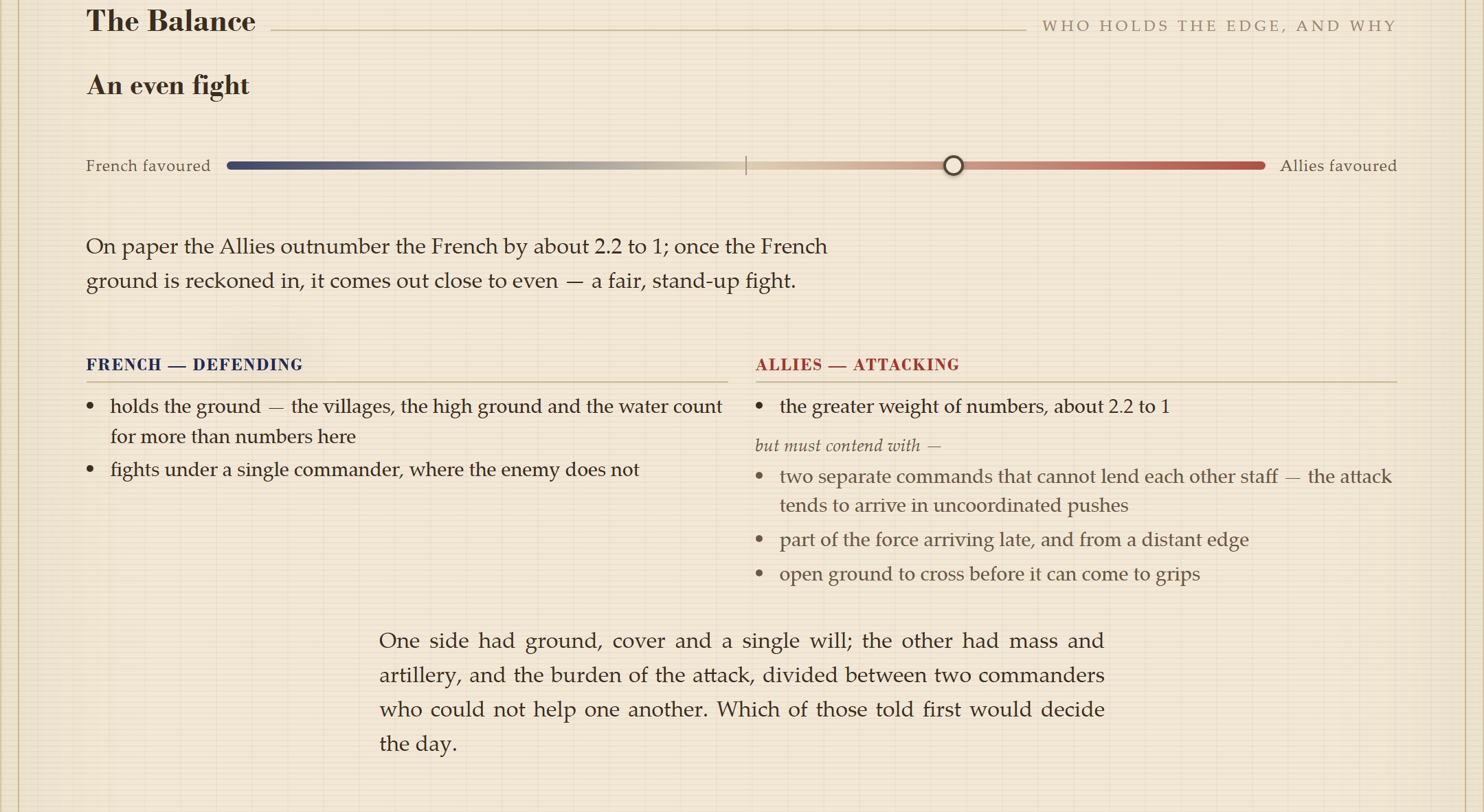
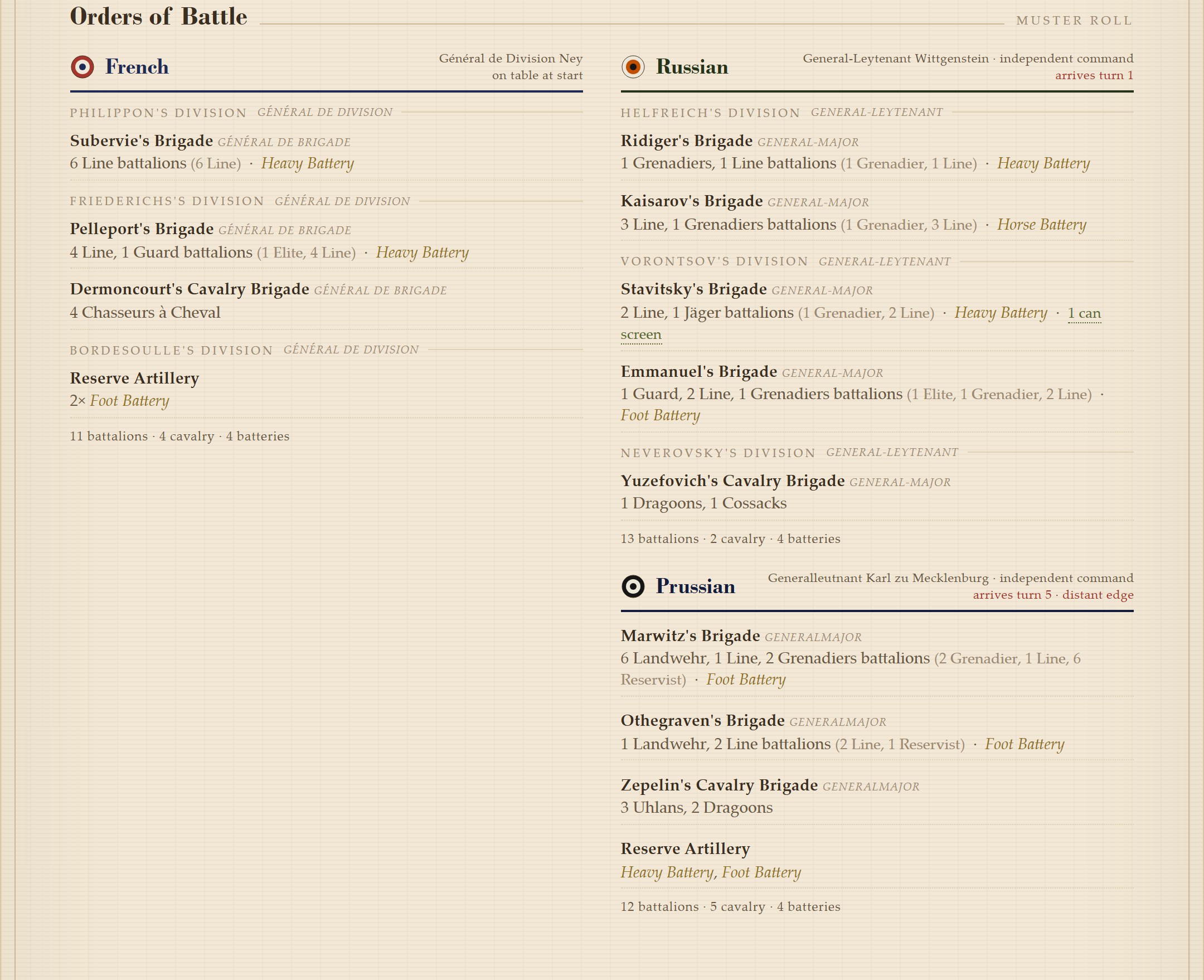
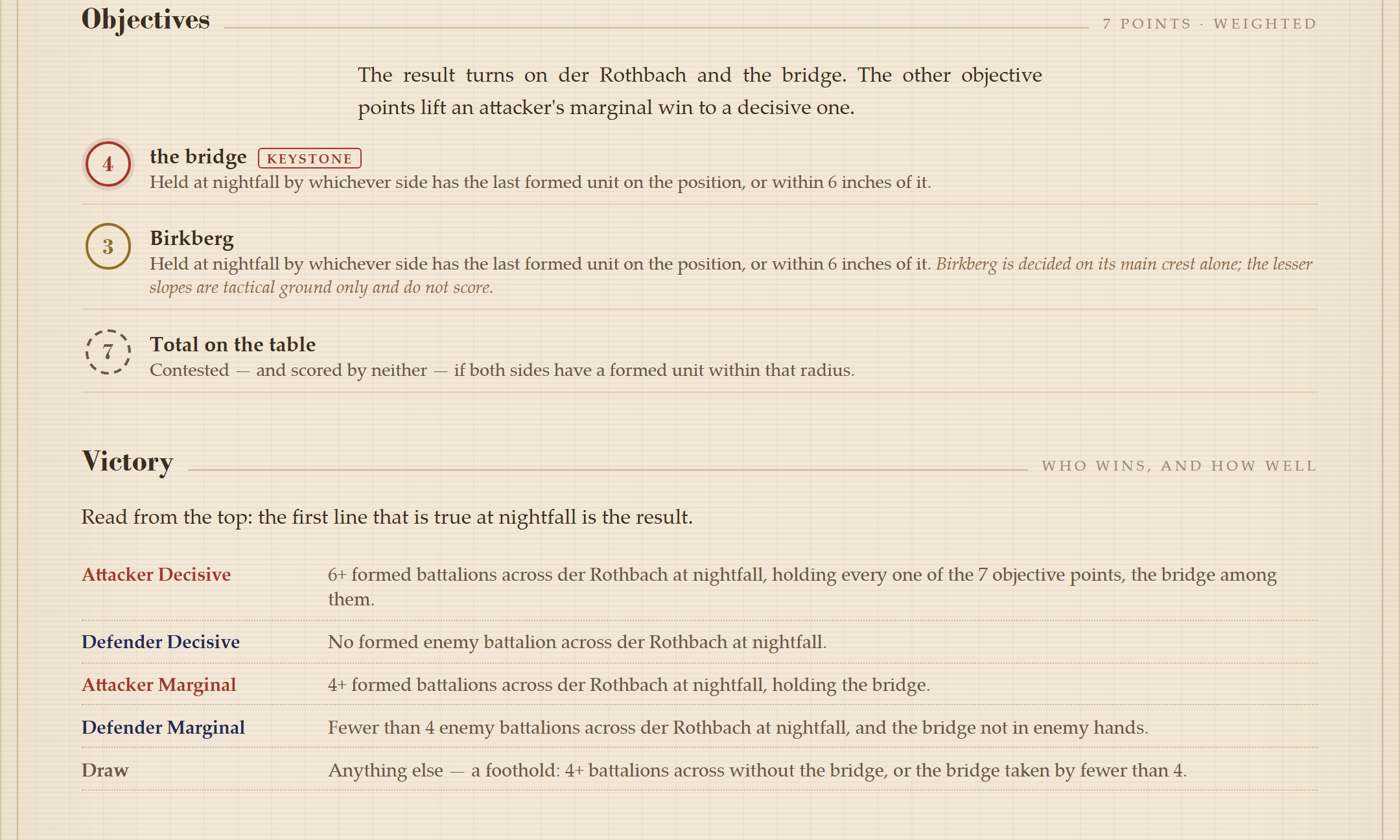
Any rules you like. Exploring Officer works with any set of Napoleonic wargames rules. A scenario is written in battalions, squadrons, guns, turns and inches — what every rule set uses and none owns — so it plays on your table with the rules already on it, whatever they are.
Save the scenario and you have the finished battle — one file, plays offline, keeps forever. That’s what to send a friend or the club. Every scenario also carries a short code, so you can find it again in your own copy of the app — see how it works.
What it stands on
Every sheet names its sources, to the page
The historical battles are built from the published orders of battle and the histories, and each sheet says which, with page numbers where the source has them. Where a source names a unit but never counts it, the unit goes on at the standard strength for its army that year, and the sheet says so. A generated action has no history to cite, so it is built to the same standard strengths. Made by a wargamer, not a historian: a guide to the game, not a work of reference.
Your collection
Tell it what you own
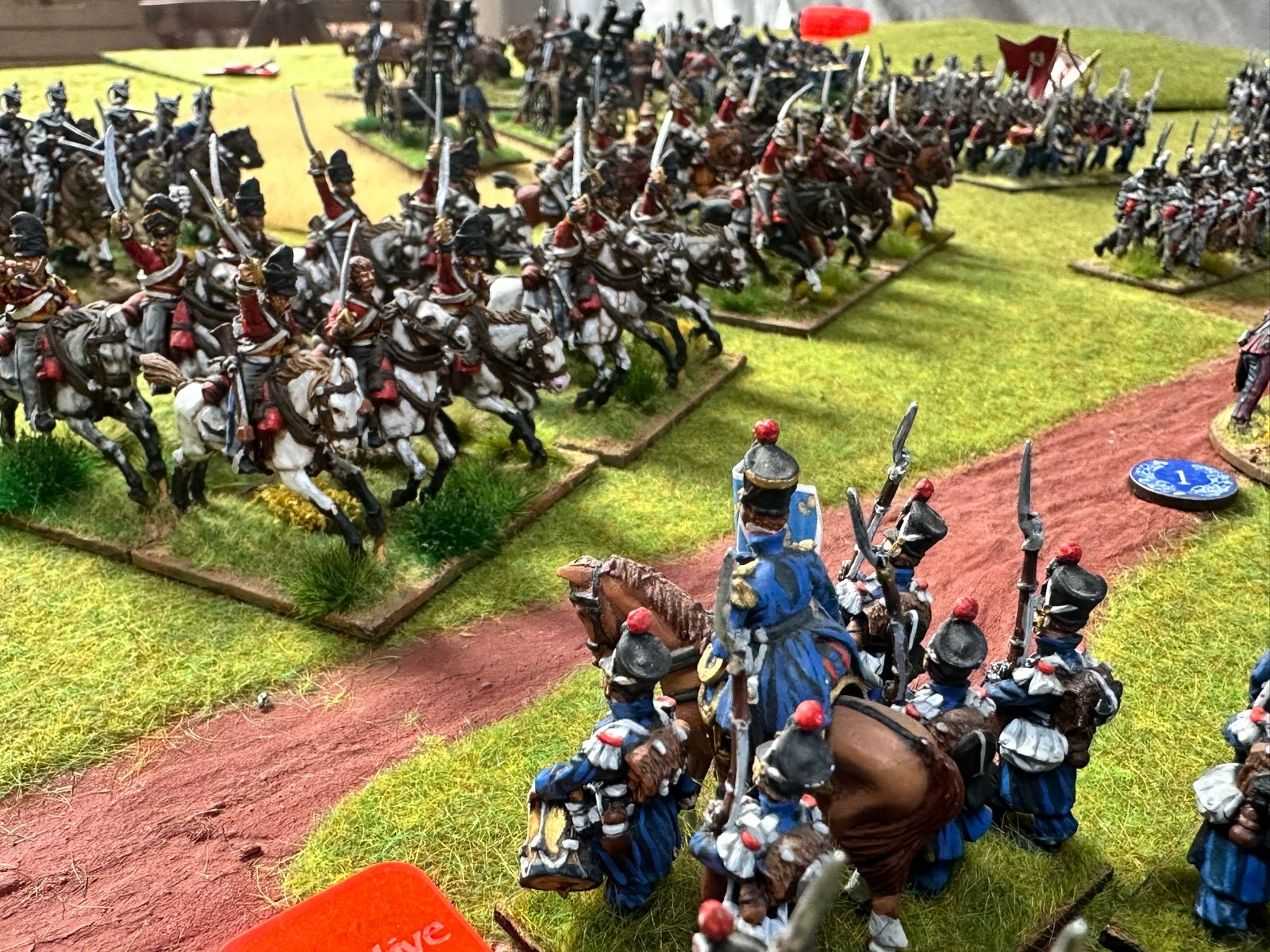
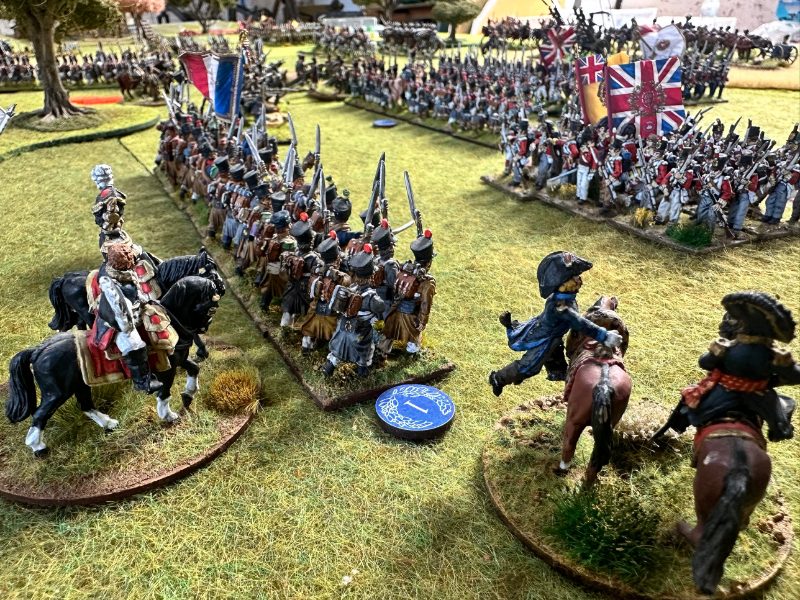
Tick the figures you have, by nation and arm. Every battle and every generated action is then measured against them: what you can field as it stands, what a friend’s figures could stand in for, and what would need a proxy. Reroll with the box ticked and it looks for a battle you can field. What you tell it stays in the browser you typed it into, and nowhere else.
Technical
What it needs
What it is
One file. Exploring Officer is a single page of HTML — about 23.6 MB, 23,647,923 bytes in this build — with every battle, every theatre and the generator inside it. Nothing to install, no account, nothing sent anywhere.
Open it in a browser and it runs, with or without an internet connection: it loads no fonts, scripts or pictures from anywhere else, and once it is open nothing is fetched. Checked on 17 September by watching the network log while it generated battles and loaded Austerlitz — the only request made was the file itself.
What it runs on
Tested in Chrome and Edge on Windows 11. Firefox and Safari not yet.
Phone and tablet: tested at phone and tablet size, not yet on a real iPad or phone. The controls stack, the sheet reads, and the full-size map opens without scrolling sideways. Save to send has not been tried on either.
Tables and distances
Tables of 14, 12, 10 and 8 feet by 6. The forces are cut to the table, not the map squashed onto it.
Distances print in inches or centimetres, whichever you choose, and the same sheet reads both ways with no arithmetic. Read them as centimetres and the 14 ft list fits a 6 × 4 ft table — the same game at half the size, which is what 15 mm figures are for.
Printing and saving
Prints from the browser’s own print dialogue. Save to send writes the finished battle to one file that opens in any browser and does not change.
Your collection
What you tell My Collection is stored in the browser you type it into — that computer only. It is not synced, it is not sent anywhere, and clearing that browser’s site data clears it. Enter it again on another machine, or keep a note.
Buying, updates and help
Early release at £15 while the next major update is being built; the price rises with it. Something wrong or something missing: feedback@vedette-wargames.com. Trouble with a download or a print: support@vedette-wargames.com.
The period in its own pictures